
Ideal Experience of Sleep in University Students:
Contextual Research.
Researched university students’ sleep behaviors to uncover barriers affecting rest quality. Combined ethnographic insights, surveys, and behavioral mapping to design holistic, user-centered interventions promoting healthier sleep habits and balanced academic lifestyles.
Role
Co-Team Lead
Timeline
10 Weeks
Type
UXR |
Graphic Des.
Tools
Figma | User Empathy Mapping, Sensory Cue Workshop,
Affinitization, Research Framework Development.
Challenge
University students struggled with fragmented sleep caused by irregular schedules, environmental discomfort, and mental overstimulation.
The challenge was understanding sleep holistically to design interventions that supported rest beyond habit tracking support.
Approach
Through observations, interviews, sensory-cue workshops, and deep synthesis, we reframed sleep as an experiential system shaped by environment, emotion, and routine, translating qualitative insights into intentional, ritual-based design interventions.
Result
The research-led solution i.e Sleep Teas.e improved nighttime consistency, reduced pre-bed mental clutter, and increased awareness of healthy sleep rituals. Students felt calmer, more in control, and better supported in transitioning into rest.

Ideal Experience of Sleep in University Students:
Contextual Research.
[Team]
Krishnika Kundu | Priyanka Rajput | Nachiket Popali | Jiahao Shen | Corrie Delva
[Key Concepts]
Non-Participatory Research | Participatory Research | Interviews | Sensory Cue Workshop | Affinity Mapping |
Research Framework Development
As Co-Lead, I began this journey by diving into the Lextant Research Framework through non-participatory and participatory methods. From observing behaviors to conducting interviews, we explored how university students experience and perceive sleep. The insights we gathered revealed emotional and physiological dimensions far beyond basic rest.
As Co-Lead, I helped facilitate a sensory cue workshop that unlocked powerful metaphors and associations tied to sleep. These exercises became the foundation of our affinity mapping and ultimately shaped our research framework—one grounded in emotion, behavior, and sensory experience.
As Co-Lead, I also co-curated a research magazine that brought data to life through infographics and storytelling. This visual consolidation made complex findings engaging and accessible. The process wasn’t just analytical—it was deeply immersive, emotional, and unforgettable.
Peek into every file here.

But how did we get here?

01
Insights from Observations
01
A general sense of agitation when the person forgets to do something- like switch the lights off- when they are ready to sleep in bed
02
Very conscious of the temperature of the room when going to bed- trying to be as warm as possible in the cold weather.
03
Inclination to always push all the things not required on the bed while sleeping on the floor in a hurry!
04
Taking time to transition out of bed in the morning (e.g., 10-20 minutes) was common, hinting at sleep inertia or insufficient restorative sleep.
05
(Most Common Observation)
Inclination to have to watch something on a digital platform before dozing off
06
(Most Common Observation)
Most of people have habits to adjust or control the atmosphere into a more comfortable atmosphere before they go to sleep.
07
(Most Interesting Observation)
A lot of the participants induce a rhythmic movement in their body to be able to fall asleep!
08
(Most Interesting Observation)
After 40-45 minutes of sleep, the individual’s eyes opened slightly while still asleep.

Stakeholder Analysis and Screening Questions
To ground our research in meaningful and diverse insights, we began by creating a detailed stakeholder map. This helped us identify all relevant actors in the ecosystem—ranging from primary users and service providers to decision-makers and peripheral influencers. By visualizing their roles, levels of influence, and touchpoints within the system, we could strategically prioritize who to interview and ensure we weren’t missing any critical perspectives or underserved voices.
Following the mapping, we designed a focused set of screening questions to validate participant relevance before scheduling interviews. These questions helped us confirm stakeholder alignment, ensure diversity across user types, and identify edge cases or outliers who could bring unique insights. The intent was to filter in participants who not only matched our criteria but also enriched the research with varied contexts and experiences—setting a strong foundation for in-depth, purposeful interviews.


Crafting the Right Interview Questions
Crafting the right interview questions was a critical step in ensuring that our conversations with stakeholders were insightful, open-ended, and aligned with our research objectives. We focused on designing questions that encouraged storytelling, surfaced lived experiences, and uncovered pain points without leading or biasing the participants. By grounding our questions in human behavior and decision-making rather than assumptions or hypothetical scenarios, we were able to tap into the emotional and functional realities of our users.
To structure these conversations effectively, we developed a comprehensive Discussion Guide that balanced consistency with flexibility. The guide was organized into thematic sections—starting with warm-up questions to build rapport, moving into deeper probes around behaviors, motivations, and frustrations, and concluding with reflective prompts to uncover unmet needs or aspirations. This framework ensured that all interviews touched on key research themes while still allowing space for spontaneous insights and unexpected directions to emerge naturally.
02
Insights from Interviews
01
"On weekdays, I usually start getting ready to sleep by taking a shower and doing my skincare routine, though scrolling through TikTok or Instagram sometimes delays my bedtime."
02
The reduction in mental pressure may positively affect the user’s overall well-being and possibly their sleep quality.
03
“I’ve learned to work smarter, but I don’t think
Graduate school has affected my sleep very much.
It’s doable work”
04
"I feel that sleep is directly tied to my productivity, and without a good night's sleep, I’d feel sluggish and unproductive during the day."
05
Quality sleep at night directly contributes to user's productivity during work or school. Naps are an essential part of their routine to maintain energy in the afternoon.
06
"I would want a superpower that helps me fall asleep more easily and allows me to regulate my body temperature. It would give me control over my sleep whenever I need it."
07
“There’s a 3 million dollar German mattress Drake uses. I hear it’s really good. That would be in my ideal sleep environment.”
08
"I think my situation is quite different from a normal person’s when it comes to sleep. Whatever solution you come up with to help me might not apply to people with regular sleeping patterns."
09
"I want to be able to track my vitals overnight with a wearable device to get more insight into my sleep quality. Even when I put my wearables on charge in the night”
10
“I like to offer tea to my student in helping her sleep better”
11
Odors from cooking, due to the bedroom being near the kitchen, can negatively impact the user's sleep.
12
"I feel that since we spend about a third of our lives sleeping, investing in a quality sleep environment is essential for enhancing our health, productivity, and overall well-being."
✪
(Most Common Shared Thought)
People are very concerned about their environment, including noise, lighting control and their sleeping environment: mattresses, pillows.
✪
(Most Common Shared Thought)
For those who moved from a different country: Their environments at home are much more comfortable compared to their living spaces now.


Activity A: Trigger & Response (Sensory Mapping Exercise)
This activity aimed to raise awareness about how different sensory stimuli affect sleep quality and emotional states. Participants were introduced to a multi-sensory kit comprising visual, auditory, olfactory, gustatory, and tactile cues—ranging from lighting samples and soundscapes to scented objects and textured materials. Using a “Sensory Canvas,” they documented their reactions to each stimulus and mapped their ideal vs. current sleep experiences. Insights revealed a strong reliance on auditory aids, widespread use of tactile comforts like silk or memory foam, and preferences for subtle smells or ambient lighting. This activity helped uncover unconscious habits and highlighted the importance of sensory control in shaping sleep behavior.


03
Sensory Cue Workshop- Activity 01: Insights
01
Each participant needed some auditory aid in helping induce their sleep.
02
Most participants currently have some attempts to improve their sleep.
03
Most participants hope to feel refreshed and productive in their ideal experience of sleep.


Activity B: Draw Your Current Sleep Timeline
(Visual Chronology)
In this visual journaling exercise, participants were asked to sketch out their existing sleep timelines—including what they do before falling asleep, during the night, and upon waking. The goal was to capture habitual routines, energy fluctuations, and disruptions in sleep patterns. Many students revealed that their academic schedules heavily influenced their sleep quality, with most experiencing fragmented or delayed sleep due to overstimulation or inconsistent routines. Some organized their nights around task completion rather than set bedtimes, and nearly all reported at least one nighttime interruption. This exercise helped visualize how daily behaviors and mental load spill over into sleep quality.


03
Sensory Cue Workshop- Activity 02: Insights
01
Sleep patterns are heavily influenced by academic schedules, daily routines, and energy fluctuations.
02
All participants experience interrupted sleep within the night.
03
Action oriented task management- some participants fixated more on the tasks they need to finish rather than the time they do it at.
Activity C: Design Your Sleep Pod (Experience Ideation)
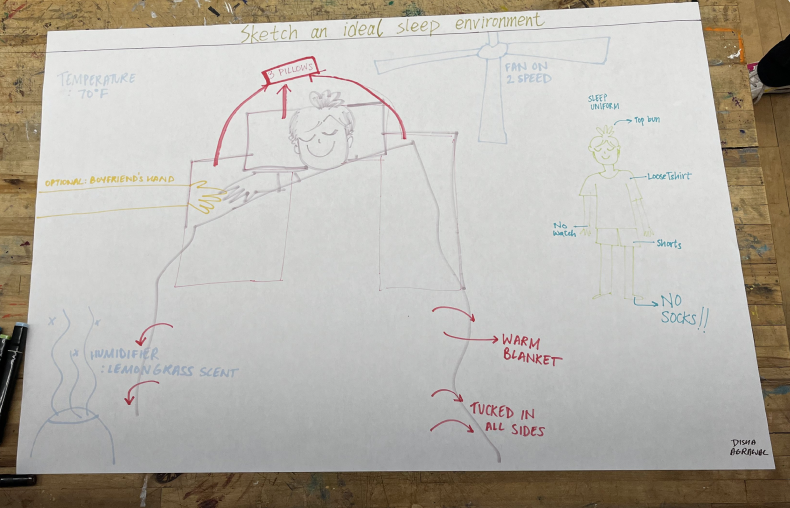
This speculative design activity invited participants to imagine and sketch their dream sleep environments using prior sensory insights. The sketches ranged from surreal and nature-infused settings to practical personal rituals and emotional comfort zones. Participants integrated details like ambient moonlight, soothing sounds, favorite textures, and the presence (or symbolic presence) of partners or pets. Interestingly, most participants focused either on indoor comfort or outdoor ambiance—rarely both—revealing individual coping strategies. The exercise brought out subconscious aspirations and emotional needs, such as safety, freedom, or predictability, underscoring the deep personal meaning attached to sleep beyond physical rest.


03
Sensory Cue Workshop- Activity 03: Insights
01
An ideal sleep environment is a blend of sensory comfort, habitual routines, and emotional security.
02
Participants seek a form of emotional comfort from their significant other- generally through touch as they fall asleep.
03
Participants tend to fixate either on the indoor or outdoor environment and not both together- basis on their preference.

Interesting thoughts




What do you want to see next?


